Chronic Back Pain and Nothing Helps: The Missing Piece
By Michael Sudbury, LMT · 7 min read
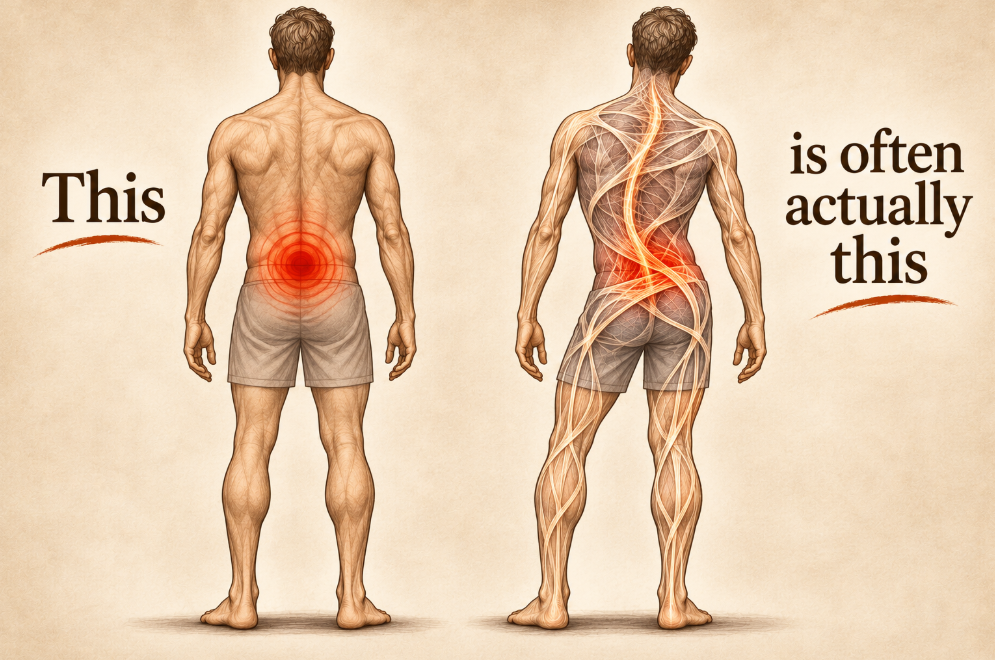
If you have chronic back pain and nothing has helped, you're not alone. It’s likely not that the things you’ve tried are bad, it’s just that most solutions have probably been focused on the symptom. Most of the time, people focus on getting rid of the painful spot, as if it’s happening in isolation. Really though, the problem is caused by the entire connected system around it. The ache in your lower back is real. But it's the result, not the source.
After 20 years of working with people who were told, “You’re getting older, just get used to it,” here's how I see it.
Why nothing has helped your chronic back pain
You've stretched. You've rested. You've had your spine adjusted, rolled out your back and legs, iced, heated, and even gotten a scan. Maybe you tried a cortisone shot. Did you do a few rounds of physical therapy, faithfully following exercises they gave you?
I bet some of it helped. For a day, anyway, maybe a week. But inevitably, the same ache came back to the same spot, again.
Eventually, something shifts. You stop trying to fix it and start wondering how to live with it. Someone tells you it's your age, or your genes, or the disc on your MRI, and you start to believe them. After all, what else is there to think?
I know how that is. I spent eight years in my own back pain. “Just deal with it," never worked for me. I kept at it, and kept getting better at understanding and helping my back. It just took me a while to put the pieces together. This is what I found.
Most approaches look at one problem spot
So how do people usually handle back pain? The spot that’s hurting gets the attention. A stiff lower back gets stretched. A disc that shows up on a scan gets the blame. A tight hip gets an exercise and activation.
Each of those makes sense, and it’s not that they’re bad. I'm glad we have physical therapists and physicians. They cover things I don't.
Most of that training, though, looks at parts. One joint, one muscle, one image at a time. And chronic back pain is rarely a one-part problem.
Your body is one connected web, not a stack of parts
Picture a big, tangled web of string. All of your joints, muscles and bones are caught up in it. Now someone asks you whether this or that loop of string is the problem.
Nope. It’s not really any one of them on its own. It’s all of them together.
The web is your connective tissue, the fascia. It wraps every muscle, bone, and organ and it's one completely continuous system from head to toe. Any kind of force on it gets distributed throughout the whole system.
So when one area gets pulled tight, from an old injury, years at a desk, or the way you brace when you're under stress, the rest of the web is affected too. The pelvis gets twisted. The spine is thrown into a curve. Forces are unevenly distributed.
You don't really feel any of that happening. You feel the place that gets overwhelmed and starts complaining.
The spot that hurts is almost never the problem
Most people have it backwards. The spot that hurts is often buckling under the load, not creating it.
Take a sweater and pull it hard by one shoulder. The whole thing twists, and the seam that rips might be on the other side, nowhere near your hand. You could sew that seam a dozen times. It will keep tearing until someone lets go of the shoulder.
That's what I see in real bodies every week. A lower back that aches because the pelvis underneath it has been rotated for years. A shoulder that won't settle because the ribs below it barely move. A knee that wears on one side because of a twist two joints up.
Stress works the same way. It isn't confined to your thoughts and moods. It shapes your body, pulling and twisting throughout the connective tissue that wraps every muscle and joint. You stopped noticing it a long time ago. But your body is still affected.
If you only ever work on the seam, it keeps tearing. Not because you're broken. Because nobody looked at the shoulder.

Pushing harder often makes it worse
Now, hold on. If the tissue is tight, shouldn't you just stretch harder, or have someone dig in deeper?

That's what most of us were taught. Push through it. No pain, no gain. And there is often benefit to this approach.
But the body treats force like a threat. When something comes at it with speed or aggression, it braces. The guarding tightens, and the deeper restrictions hold on even harder. You might get a short window of relief, but the armor comes right back, sometimes a little stronger than before.
That's why someone can stretch an hour a day for years and still feel stuck. They're working hard. The effort just isn't reaching the layer where the pattern lives.
Less effort, not more. It's not so much what you do, it's how you do it.
The doctors didn't tell you, because they didn't know to look
This is usually the first question people ask me, and it's a fair one: "If this is true, why hasn't anyone told me?"
The doctors didn't tell you, because they didn't know to look. Not because they're careless. A whole-body connective tissue pattern sits outside what most medical training focuses on. A scan shows the disc, the joint, the narrowing. It doesn't show the pull that has been loading that disc for twenty years.
So the label becomes the story. "Degeneration." "Arthritis." "It runs in the family." Those words describe what's happening at the spot. They rarely explain why it's happening.
I worked with Brent Willis, a golfer who was sure his back pain was genetic. His dad had the same problem, same sport, same pattern. Once we worked on the whole pattern, Brent played all 18 holes and beat his son. What ran in the family wasn't a gene. It was a shared way of moving, sitting and bracing.
Real change takes three things working together
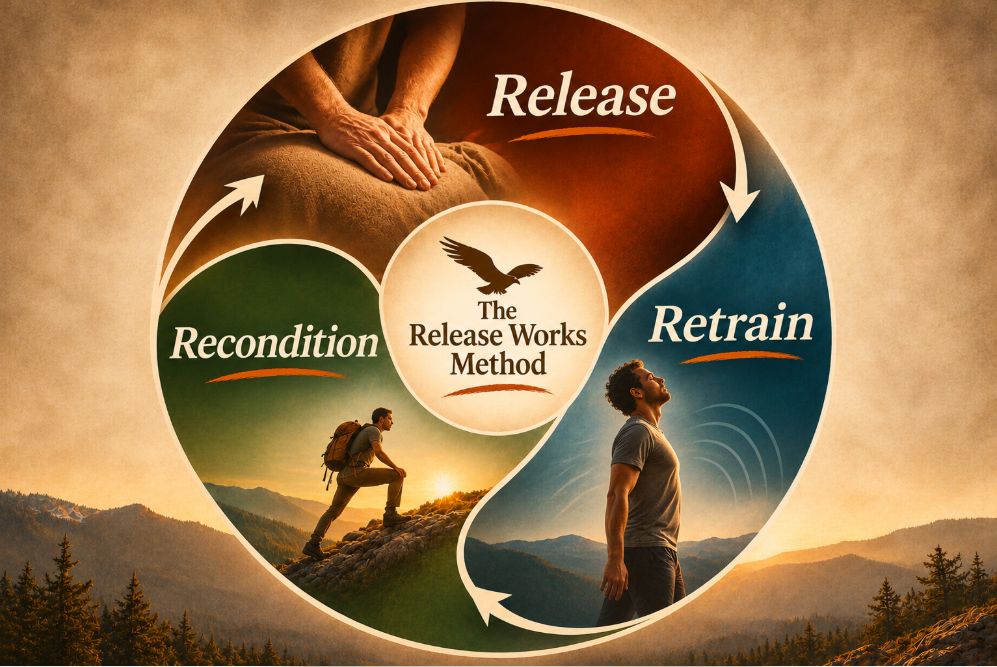
When you stop chasing the spot and start working with the whole system, three things have to happen, and they have to happen together. That's the heart of the Release Works Method.
Release. Gentle, patient, hands-on work that lets the deeper restrictions let go, without forcing. When the body stops feeling attacked, it stops guarding.
Awareness. Learning how you actually move, sit and carry yourself through the day, so you stop rebuilding the same pain and stiffness every morning.
Conditioning. Building real, full-range strength, so your body can hold its new shape under the demands of your life. Work, family, and the sport you want back.
Most approaches give you one of the three. Release without new habits, and you slide back. New habits inside a body that's still twisted, and you're fighting your own structure. Strength without either, and you're building on a crooked foundation.
Put them together and the change starts to hold. Not overnight. Healing doesn't move in a straight line. It's often two steps forward and one back as old compensations sort themselves out. But it moves, and you're the one moving it.
The goal was never to need me forever. It's teaching you to fish: understanding your own body well enough to keep it strong and capable for the rest of your life.
Chronic back pain when nothing helps: where to start
If you've tried everything and nothing has held, here's where I'd start.
Stop pushing through it. Notice where you brace when you bend, sit or lift. That bracing is information, not weakness.
Look above and below the pain. If your lower back hurts, how do your hips move? How about your ribs when you breathe? The answer is often a joint or two away.
Ask a different question. Not "what's wrong with this spot?" but "what is causing this spot difficulty?"
And if you'd like someone to look at the whole pattern with you, that's what a free Discovery Call is for. We'll talk through what's going on, what you've already tried, and whether my approach is a good fit. If it isn't, I'll tell you.
Release Works does not diagnose, treat, or prescribe. The Release Works Method of Healing™ is a movement restoration practice. Consult your physician for medical advice.